When you order lunch bags in bulk, food safety is not only about how long the bag keeps a sandwich cold. It is also about what the bag itself is made of, because the liner sits directly against food and, if the bags are aimed at kids, a set of federal and state rules decides what is allowed to be in that material at all. This guide explains the liners you will be quoted, the chemistry that separates them, and the compliance thresholds a buyer should know before signing off on a large run.
The liner is the part that touches food
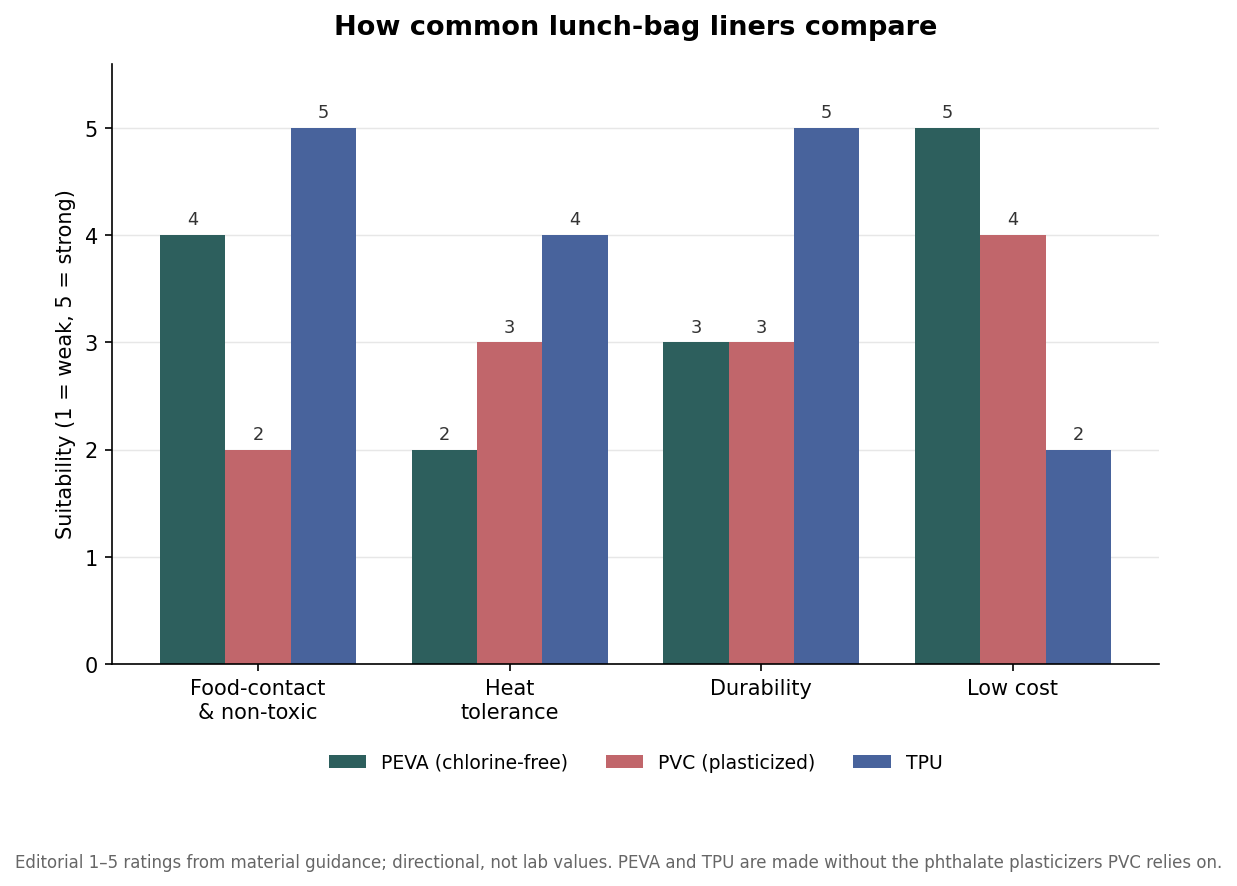
Most insulated lunch bags are built the same way: an outer shell of polyester, a middle layer of foam insulation, and an inner liner that forms the food compartment. The shell and foam are engineering choices about looks and cold retention, but the liner is the food-contact surface, so it is where material safety actually matters. The three liners you will see most often are PEVA, PVC, and TPU, and they behave very differently.
PEVA is the chlorine-free workhorse. Its chemical backbone is built without chlorine, and it reaches flexibility through a vinyl acetate component rather than added plasticizers, so it is made without the phthalates that softened PVC relies on, and it is generally BPA-free and low-VOC. It is permitted for food-contact use under FDA rules for films and laminates within defined extractive limits. Its weakness is heat: PEVA can warp or melt if you pour boiling water into it or run it through a hot dishwasher, so it suits cold lunches, not hot food or the microwave.
PVC liners are inexpensive and wipe clean well, but flexible PVC contains chlorine and typically depends on phthalate plasticizers to stay soft, and those plasticizers can migrate out of the material over time. TPU sits at the premium end: it is durable, handles heat better than PEVA, and is made without those plasticizers, but it costs more, which is why it shows up in higher-end or heavily-used bags rather than budget promotional runs.
When compliance rules kick in
The single question that changes the compliance picture is whether the bag is a children’s product. Under the Consumer Product Safety Improvement Act, a children’s product is one designed or intended primarily for children twelve and under, and those products face content limits that ordinary adult goods do not. If your lunch bags are marketed for school-age kids, decorated with characters, or sized and styled for children, assume the children’s-product rules apply and plan for testing.
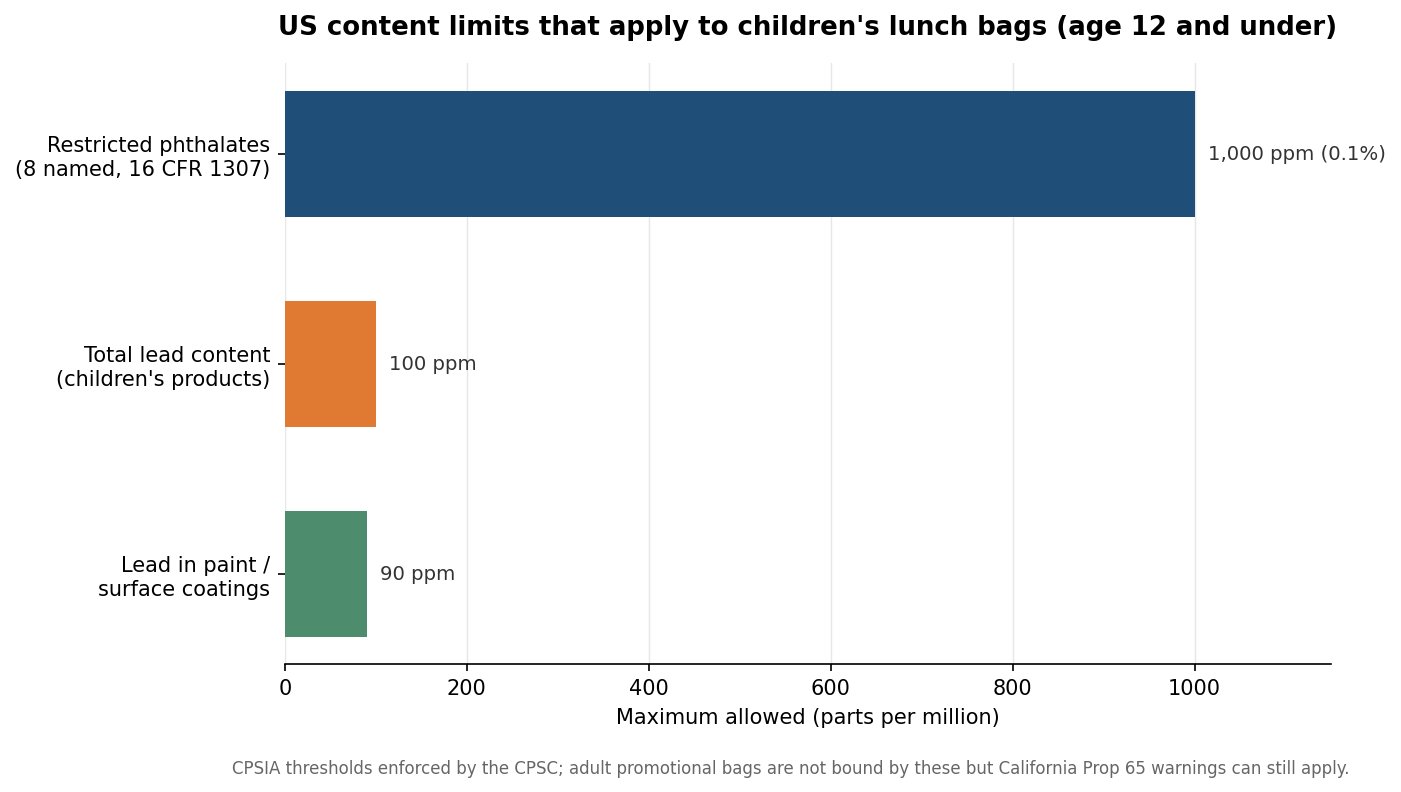
Two limits matter most. Total lead content in a children’s product is capped at 100 parts per million, and lead in any paint or surface coating is capped tighter at 90 parts per million. Separately, a group of eight named phthalates is restricted to 0.1 percent by weight, which is 1,000 parts per million, in children’s toys and childcare articles under the relevant regulation. These are not label claims you can simply assert; children’s products generally require testing by a CPSC-accepted laboratory and a Children’s Product Certificate documenting the results, using recognized test methods run by accredited labs.
Adult bags, Prop 65, and the gap people miss
If your bags are genuinely aimed at adults, the CPSIA lead and phthalate limits above do not bind them, and this is where buyers sometimes assume they are fully off the hook. They are not. California’s Proposition 65 works differently: rather than banning a substance, it requires a clear warning when a product can expose someone to a listed chemical, and both lead and the phthalate DEHP are on that list. A flexible PVC liner that leaches DEHP, or a component with trace lead, can trigger a Prop 65 warning obligation for anything sold into California, regardless of the buyer’s age. Getting a straight answer from your supplier about liner chemistry protects you here even for adult products.
The practical takeaway is to decide the audience first, because it sets the bar. A branded bag for a corporate giveaway to employees is an adult product and can lean on cost-effective PEVA with a supplier statement on chemistry and Prop 65 status. A bag destined for an elementary school, a kids’ event, or retail shelves in the children’s aisle is a children’s product and needs the lead and phthalate testing and certificate before you commit to a large quantity.
What to ask for before you approve a run
Put the safety questions in the specification rather than discovering them after delivery. Ask the supplier to name the exact liner material and confirm it is food-contact rated, and request that it be free of the restricted phthalates and, ideally, chlorine-based PVC. For any children’s product, ask for third-party test reports against the CPSIA lead and phthalate limits and a Children’s Product Certificate, and confirm which accredited lab performed the testing. For anything that may sell into California, ask directly whether a Prop 65 warning is required and, if so, who is responsible for applying it.
None of this is legal advice, and a compliance lab or attorney is the right call for a high-volume or retail program, but knowing the vocabulary changes the conversation. A buyer who asks for the liner material by name, states the intended age group, and requests the specific certificates gets a defensible order; one who assumes a supplier has handled it can end up with a warehouse of bags that cannot be sold where they were meant to go. The chemistry and the paperwork cost far less to sort out at the quote stage than after a container has shipped.